Jagna–Dominikowa mother–daughter relationship
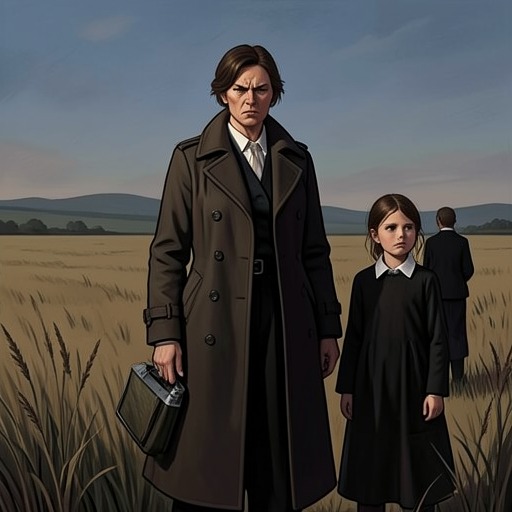
The PeasantsJagna and Dominikowa’s relationship is intimate but not aligned: when Jagna resists the prospect of a child with Maciej Boryna, her mother answers with an argument about land, inheritance, and the danger of living without property. Dominikowa presents accommodation as practical necessity, while Jagna refuses to treat either marriage or motherhood as a route to security. Their exchange makes the generational tension concrete: a mother trying to protect her daughter through the means available to her, and a daughter unwilling to accept that protection on its terms.
A Family Argument over Pregnancy and Inheritance
The conflict comes into focus when the household treats Jagna’s pregnancy as likely and discusses when the child might be born. Maciej calculates that, since it is Yuletide, the birth would come around July, during the heat and work of harvest. He says they will manage and should thank God. Jagna denies that she is pregnant and rejects the prospect as another trouble. Her mother, however, confirms the expectation rather than joining her denial, aligning herself with Maciej’s account of what is happening.
Dominikowa’s response is not limited to accepting the pregnancy. She asks Jagna whether the prospect displeases her and answers Jagna’s refusal by imagining what a child might secure: if Maciej died, she argues, his portion could be signed over to the child, perhaps even all of it. The possibility of inheritance makes pregnancy legible to her as a change in the family’s material future. Jagna immediately rejects that valuation, saying that land is all her mother thinks about and that it means little to her. Their disagreement is therefore not merely over whether Jagna is expecting a child; it is over whether property can justify accepting a life she does not want.
Dominikowa’s Counsel and Jagna’s Resistance
Dominikowa frames her advice as a warning about the consequences of having no land. She tells Jagna that she is young and foolish, and compares a landless person to a body without legs, rolling without getting anywhere. On that reasoning, Jagna should not oppose Maciej or make him morose. The counsel combines maternal instruction with a hard appraisal of vulnerability: the daughter’s feelings matter, but her mother treats property as the condition that makes a secure life possible.
Jagna does not answer with a competing plan for obtaining land. Instead, she says she will not keep her feelings inside and insists that she does not care about Maciej. The bluntness exposes the limit of Dominikowa’s argument. A prospective inheritance may appear valuable to the mother, but it cannot make Jagna’s attachment to her husband real. Dominikowa counters that Jagna should stop complaining or the Lord Jesus will punish her, invoking religious sanction where persuasion has failed. The appeal presses her daughter toward endurance without resolving the difference between them.
Domestic Work and the Household’s Immediate Needs
The conversation ends not in reconciliation but in a turn back to work. Dominikowa tells Jagna to stop talking and concentrate on taking the bread out before it burns. She assigns further tasks: the herring is to be moved from water into milk to lose salt, and Józka can grind poppy seeds. The evening is approaching and there is still much to do. This practical interruption gives the exchange its domestic setting: even a consequential disagreement about pregnancy, marriage, and inheritance unfolds amid food preparation and the labor that keeps the household going.
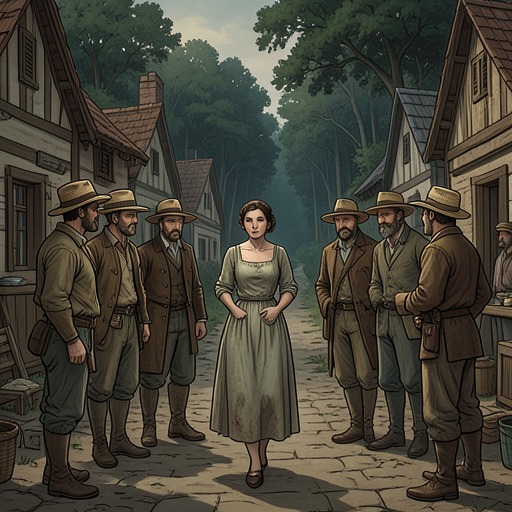
That material setting helps explain why Dominikowa’s reasoning repeatedly returns to land and subsistence. Before the fair, Lipce households calculate what they can sell and what they must buy, while taxes, commune contributions, debts, and payments to servants press on scarce ready money. Even households with fifteen morgen find little room in their calculations; poorer families face still less security. The village’s seasonal economy does not establish Dominikowa’s private motives beyond what she says, but it clarifies the force of her insistence that landlessness leaves a person unable to get anywhere.
Maternal Authority within a Wider Economy of Labor
The burden of household survival also falls unevenly across the village. During the imprisonment of the men, women are left to manage livestock, children, gardens, wood, and the many tasks of spring, while the fields remain fallow for want of working hands. Later, when neighboring villagers arrive to help Lipce, carts, ploughs, and people fill the previously empty fields; the community’s recovery depends on labor being mobilized as well as on land being available. These broader conditions illuminate the practical world in which Dominikowa counsels her daughter, though they do not make the two women’s choices identical to those of other households.
The scene thus defines a relationship in which care takes the form of pressure. Dominikowa offers Jagna a strategy grounded in property, obedience, and the prospect of inheritance; Jagna answers from her refusal to value Maciej or land in the same way. The mother’s advice may be protective in its attention to material security, but it also asks her daughter to suppress her objection. Their exchange leaves that tension unresolved, with the bread, herring, and poppy seeds waiting as the ordinary work of the household resumes.